01
Traditional Japanese Hoshigaki (Dried Persimmons)
Whole peeled astringent persimmons hung, sun-dried, and massaged daily for weeks until a natural white bloom of crystallized sugars forms on the surface.
 Mapple Health
 Persimmon (Diospyros kaki), known across South Asia as Japani Phal (“Japanese Fruit”) and in East Asia as Kaki, is a vibrant autumn fruit prized for its flame-orange color, honey-like sweetness and silky texture. Available in two distinct forms—crisp non-astringent varieties (like Fuyu) and astringent varieties (like Hachiya)—persimmon provides dietary fiber, beta-carotene, lutein, zeaxanthin, vitamin C and manganese.
This guide covers persimmon nutrition, what research actually supports about its health effects, the critical difference between Fuyu and Hachiya varieties, how to choose and ripen persimmons, and important safety information including the documented risk of diospyrobezoars from unripe fruit.
Understanding the difference between these two types is essential—both for enjoyment and for safety:
| Feature | Fuyu (Non-Astringent) | Hachiya (Astringent) |
|---|---|---|
| Shape | Squat, tomato-shaped | Acorn-shaped, elongated |
| When to Eat | Firm and crisp, like an apple | Only when completely soft and jelly-like |
| Tannin Level (Unripe) | Low; pleasant when firm | High soluble shibuol tannins; extremely astringent when firm |
| Texture When Ripe | Crisp to slightly soft | Silky, custard-like, translucent |
| Safety When Unripe | Safe to eat firm | Can cause diospyrobezoars if eaten firm in large quantities |
| Best Use | Salads, slicing, snacking | Puddings, baking, eating with a spoon |
Much online content presents persimmon as a proven cholesterol-lowering, diabetes-managing superfruit. The actual evidence is more nuanced:
| Health Focus Area | What the Evidence Shows | Strength and Limits |
|---|---|---|
| Cholesterol | A tannin-rich fiber extract from persimmon reduced cholesterol in a human trial. | Promising but indirect. The trial tested isolated tannin fiber, not whole fruit. |
| Lipase Inhibition | Persimmon polyphenols inhibited pancreatic lipase in laboratory assays. | Preclinical only. The study used persimmon leaf tea extracts, not fresh fruit, and tested them in vitro. |
| Eye-Related Nutrients | Persimmon provides lutein and zeaxanthin, carotenoids found in macular pigment. | Nutritionally relevant. No human trial links persimmon consumption to macular protection. |
| Blood Sugar | Persimmon contains meaningful carbohydrate; published GI values vary by study. | Variable. Not a universally “low-GL” food; portion size matters for people with diabetes. |
| Antioxidant Capacity | Laboratory studies show antioxidant activity from persimmon polyphenols. | Preclinical. Direct human disease prevention is unproven. |
| Antiviral Activity | In vitro studies demonstrate tannin-derived antiviral properties. | Strictly laboratory. No clinical application has been established. |
This distinction matters: laboratory and extract studies can be informative, but they do not carry the same weight as randomized human trials using whole fruit.
The most-cited persimmon cholesterol study (Gato et al., 2013, PMID: 23171573) is a legitimate randomized, double-blind, placebo-controlled trial, but it is important to understand exactly what it tested:
What the study does not prove: That eating one fresh persimmon per day produces the same cholesterol-lowering effect. The tannin fiber was extracted, concentrated and delivered at specific doses that may not be replicated by eating whole fruit. The direction of the evidence is encouraging, but the claim needs to be stated accurately.
The 2026 study (Bhuiya et al., PMID: 42543621) often cited for persimmon’s metabolic benefits actually studied persimmon leaf tea extracts, not fresh persimmon fruit. The experiments were laboratory assays involving porcine pancreatic lipase—not a human clinical trial. This research cannot be used to claim that eating fresh persimmon reduces fat absorption or aids diabetes management.
Persimmon contains meaningful carbohydrate—approximately 31g per medium fruit—so it is not a “free” food for people managing blood sugar. The glycemic picture is also less clear-cut than some sources suggest:
The practical conclusion: People with diabetes can include persimmon in their diet, but the fruit contains meaningful carbohydrate and portion size matters. Pairing persimmon with protein or healthy fats (such as nuts or yogurt) can help moderate glycemic response. Persimmon should be counted within an individual meal plan, not marketed as a universally “low-GL” diabetes food.
Persimmon provides approximately 834µg of lutein and zeaxanthin per 100g (about 1401µg per medium fruit), along with 15% DV of vitamin A as beta-carotene. Lutein and zeaxanthin are the specific xanthophyll carotenoids that accumulate in the eye’s macular pigment, where they function as internal blue-light filters.
However, no human clinical trial has demonstrated that eating persimmon prevents macular degeneration or protects retinal health. Trials that have shown changes in macular pigment density have generally used concentrated lutein/zeaxanthin supplements at substantially higher doses than what one persimmon provides. The accurate statement is that persimmon provides carotenoids involved in eye physiology—not that it “protects the macula.”
A medium persimmon delivers approximately 6g of dietary fiber—nearly a quarter of daily recommendations. This fiber includes both soluble pectin and insoluble components:
For individuals seeking to increase fiber intake, ripe persimmon eaten with adequate water provides a convenient whole-fruit option.
Persimmons—particularly unripe astringent varieties—are well documented in the medical literature as a cause of diospyrobezoars, a specific type of stomach stone (phytobezoar):
When unripe astringent persimmons (Hachiya-type) are consumed, soluble shibuol tannins react with stomach acid and coagulate with plant fiber, forming a hard mass in the stomach. These stomach stones can cause pain, nausea, vomiting and, in severe cases, intestinal obstruction requiring medical intervention.
The risk is rare and especially associated with:
UC Davis confirms that persimmons are highly sensitive to ethylene, which accelerates softening. To ripen firm Hachiya persimmons at home:
Ripe persimmons are generally considered safe and nutritious during pregnancy. A medium fruit provides:
As with all fresh fruit, wash persimmons thoroughly before eating. Include them as part of a varied prenatal diet rather than relying on any single food for specific nutritional needs.
A medium persimmon provides approximately 270mg of potassium. The National Kidney Foundation considers foods with 200mg or more per serving as higher-potassium foods. Suitability depends on the individual’s blood potassium level and prescribed renal diet plan. 2. IBS & Low-FODMAP Diets: Persimmons contain fructose, which can trigger gas or bloating in people with fructose sensitivity or active IBS. Individual tolerance varies, so portion size matters. 3. Carbohydrate Tracking in Diabetes: One medium persimmon provides about 31g of carbohydrate. Portions should be counted within an individualized meal plan. 4. Unripe Astringent Fruit: Never eat firm Hachiya persimmons. The diospyrobezoar risk, while rare, is a documented medical concern.
Traditional hoshigaki is an artisanal preservation method practiced for centuries in Japan and Korea. Astringent persimmons are peeled whole, hung from rafters by strings, and periodically hand-massaged during weeks of slow air-drying. The careful process breaks down astringent tannins while concentrating natural sugars. The characteristic white bloom on the surface is crystallized sugars—not mold—and signals that the drying process is complete.
Hoshigaki demonstrates how traditional food cultures developed practical solutions to make astringent persimmons safe and enjoyable long before the underlying tannin chemistry was scientifically understood.
| Region | Common Name | Cultural Note |
|---|---|---|
| Japan | Kaki (柿) | One of the oldest cultivated fruits; deeply embedded in autumn culture and cuisine |
| Korea | Gam (감) | Central to traditional dried persimmon (gotgam) and autumn harvest festivals |
| South Asia | Japani Phal | A regional name reflecting the fruit’s strong historical association with Japanese cultivation; grown in northern Pakistan, Kashmir and highland India |
| Spain | Caqui / Kaki | Major European producer, especially the Ribera del Xúquer region of Valencia |
| Israel | Sharon Fruit | Commercial name for treated Triumph persimmons, with astringency removed after harvest |
Persimmon is a nutritious autumn fruit that provides dietary fiber, beta-carotene, lutein, zeaxanthin, manganese and vitamin C. The most compelling research direction is the cholesterol-lowering potential of persimmon tannin fiber, though the key clinical trial tested an isolated extract rather than whole fruit. Eye-related carotenoids are genuinely present, but clinical proof of macular protection from eating persimmon does not yet exist.
The most important practical knowledge about persimmons is the distinction between Fuyu and Hachiya varieties: Fuyu can be eaten crisp, while Hachiya must be fully ripened to avoid both an unpleasant experience and a documented medical risk. With that understanding, persimmon is a genuinely enjoyable and nutritious addition to an autumn diet.
Official USDA FoodData Central values for 100 grams of raw Japanese persimmon flesh, alongside approximate values for 1 medium fruit (168g). Nutritional values vary naturally across cultivars and ripeness stages:
| Nutrient | Amount (per 100g) | Amount (per 1 medium Japanese persimmon (168g)) | % Daily Value (%DV) | Why Your Body Needs It |
|---|---|---|---|---|
| Calories | 70 kcal | 118 kcal | — | Nutrient-dense autumn energy |
| Total Carbs | 18.6g | 31.2g | 11% | Complex fruit sugars bound with dietary fiber |
| Sugars | 12.5g | 21.0g | — | Naturally occurring fructose and glucose |
| Dietary Fiber | 3.6g | 6.0g | 24% | Soluble and insoluble fiber contributing to normal digestion |
| Protein | 0.58g | 0.97g | 2% | Small natural amino acid contribution |
| Total Fat | 0.19g | 0.32g | <1% | Virtually fat-free |
| Vitamin A (Beta-Carotene) | 81µg RAE | 136µg RAE | 15% | Provitamin A carotenoid for vision and immune function |
| Vitamin C | 7.5mg | 12.6mg | 14% | Antioxidant protection and collagen synthesis |
| Manganese | 0.35mg | 0.59mg | 26% | Essential cofactor for antioxidant defense enzymes |
| Potassium | 161mg | 270mg | 6% | Supports fluid balance and normal vascular function |
| Lutein & Zeaxanthin | 834µg | 1401µg | — | Carotenoids concentrated in the retina and macular pigment |
The reference matrix below summarizes how persimmon consumption interacts with specific health conditions based on available evidence:
| Health Focus Area | Clinical Status | Practical Guidance | Scientific Evidence & Nuance |
|---|---|---|---|
| Cholesterol | Promising | Include ripe persimmon in a varied diet | Promising but indirect evidence. A human trial (PMID: 23171573) found that tannin-rich fiber isolated from persimmon fruit lowered total cholesterol and LDL in 40 participants over 12 weeks. However, the study tested concentrated tannin fiber in cookie bars, not whole fresh persimmon. Whether eating whole fruit produces comparable effects has not been clinically demonstrated. |
| Eye-Related Nutrients | Nutritionally Relevant | Include as part of a carotenoid-rich diet | Provides carotenoids involved in eye physiology. A medium persimmon delivers approximately 1401µg of lutein and zeaxanthin, carotenoids found in the macular pigment. However, no human trial has demonstrated that eating persimmon specifically prevents macular degeneration. |
| Diabetes / Blood Sugar | Portion Aware | Count carbohydrates; ½ to 1 fruit with protein or fats | Meaningful carbohydrate content. A medium persimmon provides approximately 31g of carbohydrate. Published GI values vary by variety and study (some report ~50, others ~61). People with diabetes can include persimmon, but portions should be counted within an individual meal plan. |
| Weight Management | Practical | A filling whole-fruit snack | Moderate calories with good fiber. At 118 kcal per medium fruit with 6g of fiber, persimmon can be a filling snack within an overall calorie-aware eating pattern. It has no special fat-burning effect. |
| Pregnancy | Generally Safe | Wash thoroughly; eat ripe fruit | Safe and nutritious when ripe. Provides dietary fiber, beta-carotene (as safe provitamin A), manganese and vitamin C. Include ripe persimmons as part of a varied prenatal diet. |
| Digestive Health | Beneficial | Eat ripe persimmons with adequate water | Good fiber source. Delivers 6g of dietary fiber per medium fruit, contributing to normal bowel function. Soluble fiber can be fermented by gut microbes, though individual responses vary. |
| Kidney Disease (CKD) | Individualized | Discuss portions with a renal dietitian | Moderate potassium per serving. A medium 168g persimmon provides approximately 270mg of potassium. The National Kidney Foundation considers foods with 200mg or more per serving as higher-potassium foods. Suitability depends on the individual's blood potassium level and prescribed renal diet. |
| Diospyrobezoar Risk (Unripe Fruit) | Avoidable Risk | Always eat astringent varieties fully ripe | Documented medical risk from unripe astringent persimmons. Unripe Hachiya-type persimmons contain soluble shibuol tannins that can coagulate with stomach acid, forming stomach stones (diospyrobezoars). The risk is rare and especially associated with substantial consumption and susceptible individuals. Full ripening greatly reduces soluble tannins, making ripe fruit suitable for normal consumption. |
| Children & Toddlers | Age-Appropriate | Serve soft, fully ripe flesh in appropriate form | Safe when prepared appropriately. Soft ripe persimmon flesh can be spooned for toddlers. A digestible source of beta-carotene, fiber and manganese. |
| Pets (Dogs) | Caution | Flesh only in small amounts; remove all seeds | Seed and pit hazard. Persimmon flesh is not toxic in small amounts, but seeds can cause intestinal inflammation and blockage in dogs. Always remove seeds and consult a veterinarian. |
| IBS (FODMAPs) | Dose-Dependent | Limit to ½ fruit per sitting if sensitive | Contains fructose. People with IBS who are following a low-FODMAP diet may need to limit persimmon portions because the fruit contains fructose, which can trigger gas or bloating in sensitive individuals. Individual tolerance varies. |
A practical growing profile for this fruit. Conditions vary by variety, climate and location.
| Growing Factor | What to Know |
|---|---|
| Climate | Warm temperate to subtropical climates with hot summers and cool winters; Asian persimmons tolerate light frost, but cultivar cold-hardiness varies |
| Sunlight | Full sun is best for strong growth, flowering and fruit production; at least 6 hours of direct sunlight is ideal |
| Soil | Deep, fertile, well-drained loamy soil is preferred, although persimmons tolerate a fairly wide range of soil types |
| Ideal soil pH | About 6.0–6.5 is ideal for Japanese persimmon, with good drainage more important than exact pH |
| Water needs | Regular moisture during establishment and fruit development; established trees tolerate some drought, but prolonged water stress can reduce fruit quality and yield |
| Planting | Late winter to early spring while trees are dormant, or during other mild frost-free planting periods depending on local climate |
| Pollination | Many Japanese persimmon cultivars can set seedless fruit without pollination, but cross-pollination can improve fruit set and yield in some cultivars |
| Pruning | Train young trees to develop a strong framework; mature trees generally need only light pruning to remove dead, damaged, crossing branches and unwanted suckers |
| Thinning | Heavy crops can contribute to smaller fruit and alternate bearing; thinning young fruit may help improve fruit size and reduce biennial bearing |
| Main risks | Scale insects and mealybugs, Leaf spot diseases, Root and crown rot in poorly drained soil, Fruit drop, especially with excess nitrogen, stress or very heavy crops, Late spring frost damage to flowers, Bird and wildlife damage as fruit ripens |
Explore visual varieties and characteristics.
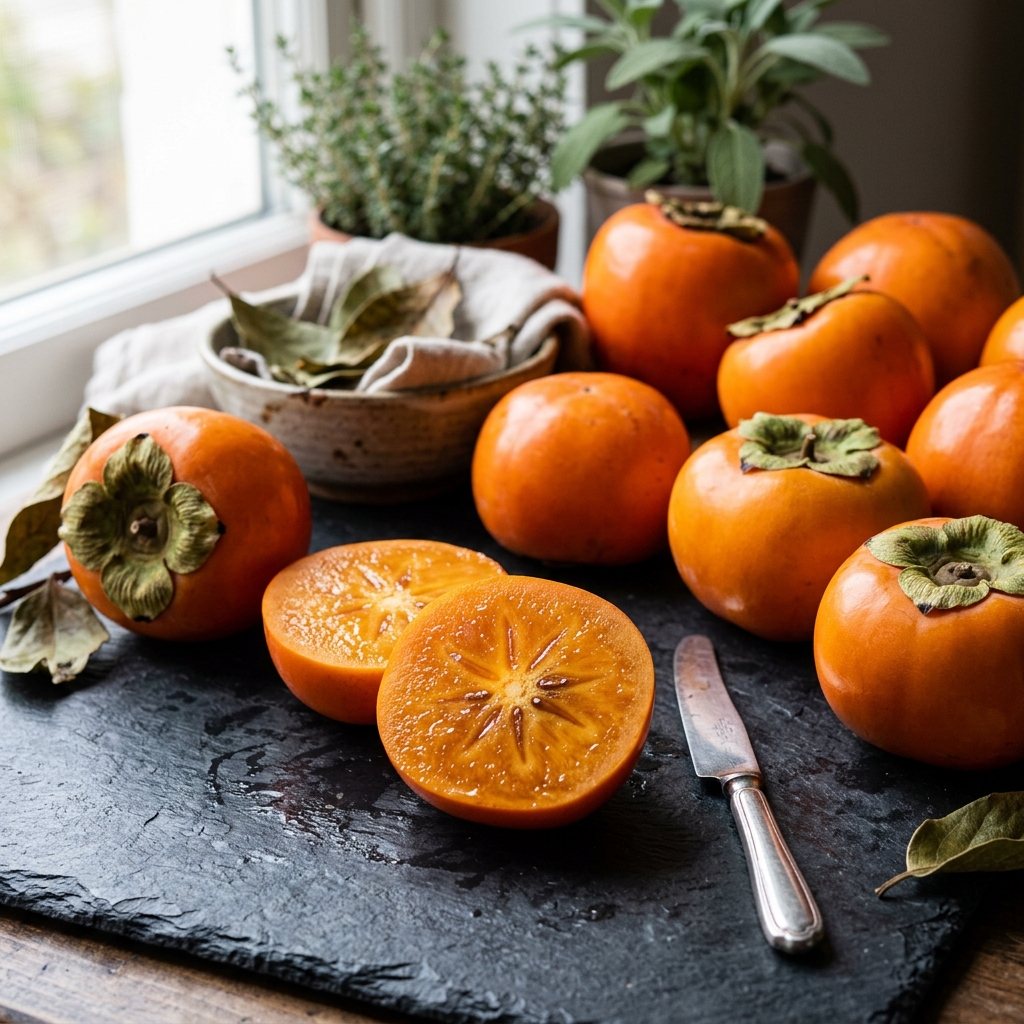
Eat squat Fuyu persimmons while crisp, sliced like an apple. Always allow acorn-shaped Hachiya persimmons to ripen until completely soft and jelly-like before eating with a spoon—eating them firm causes an intensely astringent, mouth-puckering experience.
Combine fresh persimmon slices with walnuts, almonds or Greek yogurt. Fat-soluble carotenoids like beta-carotene and lutein are absorbed more effectively when consumed alongside dietary fat.
Place firm Hachiya persimmons in a paper bag with an apple or banana to accelerate ethylene-driven softening. Exact ripening time depends on the starting firmness and ambient temperature.
One medium persimmon provides about 6g of dietary fiber. Enjoy ripe fruit as part of a varied diet; avoid eating excessive amounts of unripe fruit, especially on an empty stomach.
Traditional preparations and global recipes celebrating wholesome ingredients, balanced textures, and rich culinary heritage.
Whole peeled astringent persimmons hung, sun-dried, and massaged daily for weeks until a natural white bloom of crystallized sugars forms on the surface.
Crisp Fuyu persimmon wedges tossed with fresh pomegranate arils, baby spinach, toasted pecans, and a light citrus vinaigrette.
Naturally sweet, jelly-soft ripe Hachiya persimmon pulp blended with cinnamon, nutmeg, and almond milk into a rich no-bake pudding.
Pureed ripe persimmons baked into a spiced whole-grain quick bread with crushed walnuts and golden raisins.
A human trial (Gato et al., 2013, PMID: 23171573) found that a tannin-rich fiber extract isolated from persimmon fruit reduced total cholesterol and LDL in participants with elevated cholesterol over 12 weeks. However, the study tested concentrated tannin fiber delivered in cookie bars at specific doses, not fresh whole persimmon. Whether eating one whole persimmon daily produces the same effect has not been clinically demonstrated.
Fuyu persimmons are non-astringent, squat and tomato-shaped, and can be eaten while firm and crisp like an apple. Hachiya persimmons are acorn-shaped and astringent when unripe; they must be allowed to ripen until completely soft and jelly-like before eating, otherwise the high soluble tannin content causes an intensely unpleasant mouth-puckering sensation.
Persimmon provides lutein and zeaxanthin (approximately 834µg per 100g), which are carotenoids found in the eye's macular pigment. However, there is no human clinical trial demonstrating that eating persimmon specifically protects the macula or prevents retinal degeneration. Trials showing changes in macular pigment density have generally used concentrated lutein/zeaxanthin supplements.
In moderation, yes. Persimmon contains meaningful carbohydrate (about 31g per medium fruit). Published glycemic index values for persimmon vary by variety and study—some datasets report GI around 50, while others report higher values around 61. People with diabetes can include persimmon in their diet, but the carbohydrate contribution should be counted within their individual meal plan, and pairing with protein or healthy fats can help moderate glycemic response.
Yes. Ripe persimmons provide dietary fiber, beta-carotene (as provitamin A), manganese and vitamin C. They are generally considered safe during pregnancy when washed thoroughly and eaten ripe. As with any fruit, they should be part of a varied diet.
Small amounts of persimmon flesh are not toxic to dogs, but persimmon seeds and pits can cause intestinal inflammation and blockage. Always remove seeds and serve only small portions of flesh. Consult a veterinarian about your pet's individual diet.
A diospyrobezoar is a type of stomach stone (phytobezoar) that can form when high amounts of soluble shibuol tannins from unripe astringent persimmons coagulate with stomach acid and plant fiber. The risk is especially associated with substantial consumption of tannin-rich unripe persimmons and is more common in susceptible individuals. Full ripening greatly reduces astringency and soluble tannins, making Hachiya persimmons suitable for normal consumption. The documented bezoar risk is mainly associated with substantial intake of tannin-rich unripe or partially ripe fruit.
Place firm Hachiya persimmons in a paper bag with an ethylene-producing fruit such as an apple or banana. Ethylene accelerates softening, though the exact time depends on starting firmness and temperature. The persimmon is ready when it feels like a water balloon and the flesh is completely soft and jelly-like.
Ripe persimmon has a rich, honey-like sweetness with notes of brown sugar and apricot. Crisp Fuyu persimmons have a mild, apple-like crunch with subtle sweetness, while fully ripe Hachiya persimmons are intensely sweet with a silky, custard-like texture.
Japani Phal is called persimmon in English. The fruit covered in this guide is Japanese persimmon, Diospyros kaki.
'Japani Phal' is a South Asian regional name meaning 'Japanese fruit,' reflecting the fruit's strong historical association with Japanese cultivation. Diospyros kaki itself has a broader Asian botanical origin.
One medium persimmon provides about 118 calories and 6g of fiber. Its fiber can make it a satisfying whole-fruit snack, but persimmon has no special fat-burning effect.
Persimmon provides vitamin C, beta-carotene and other carotenoids that contribute to normal skin function and antioxidant defenses. However, there is no good clinical evidence showing that eating persimmon specifically treats or improves a particular skin condition.
Have a moment? Share your feedback or suggestions via Google to help us produce even higher quality, evidence-based nutrition guides.
No saved articles yet.
Click the bookmark button inside any article to save it here for offline reading!
Hi! I am Mapple AI, your food science research companion. Ask me anything about biomolecules, organic diet patterns, or longevity recipes.